Catalogue de ligatures · a catalogue system since 1999
What belongs together stays connected.
In notation, a ligature binds notes into one gesture. The Catalogue de ligatures binds works, people, places and events the same way: each is recorded once, and everything else refers to it.
The idea
Art is not a set of lists. It lives in its relationships.
A work is performed, recorded, discussed, published and taught. A performer plays many works. A hall hosts many concerts. A publisher carries a whole catalogue. Written into separate lists, the same names are typed again and again — and quietly drift apart.
The catalogue takes a different path. It gives each kind of record its own place, holds every person, venue and event exactly once, and draws threads between them. Correct a name in one place, and every work that points to it is corrected in the same moment.
The system began in 1999 with a catalogue of works for a publishing house founded by a group of composers. It has grown since; the idea has not changed.
The collections
Everything a musical life brings forth, each in its place.
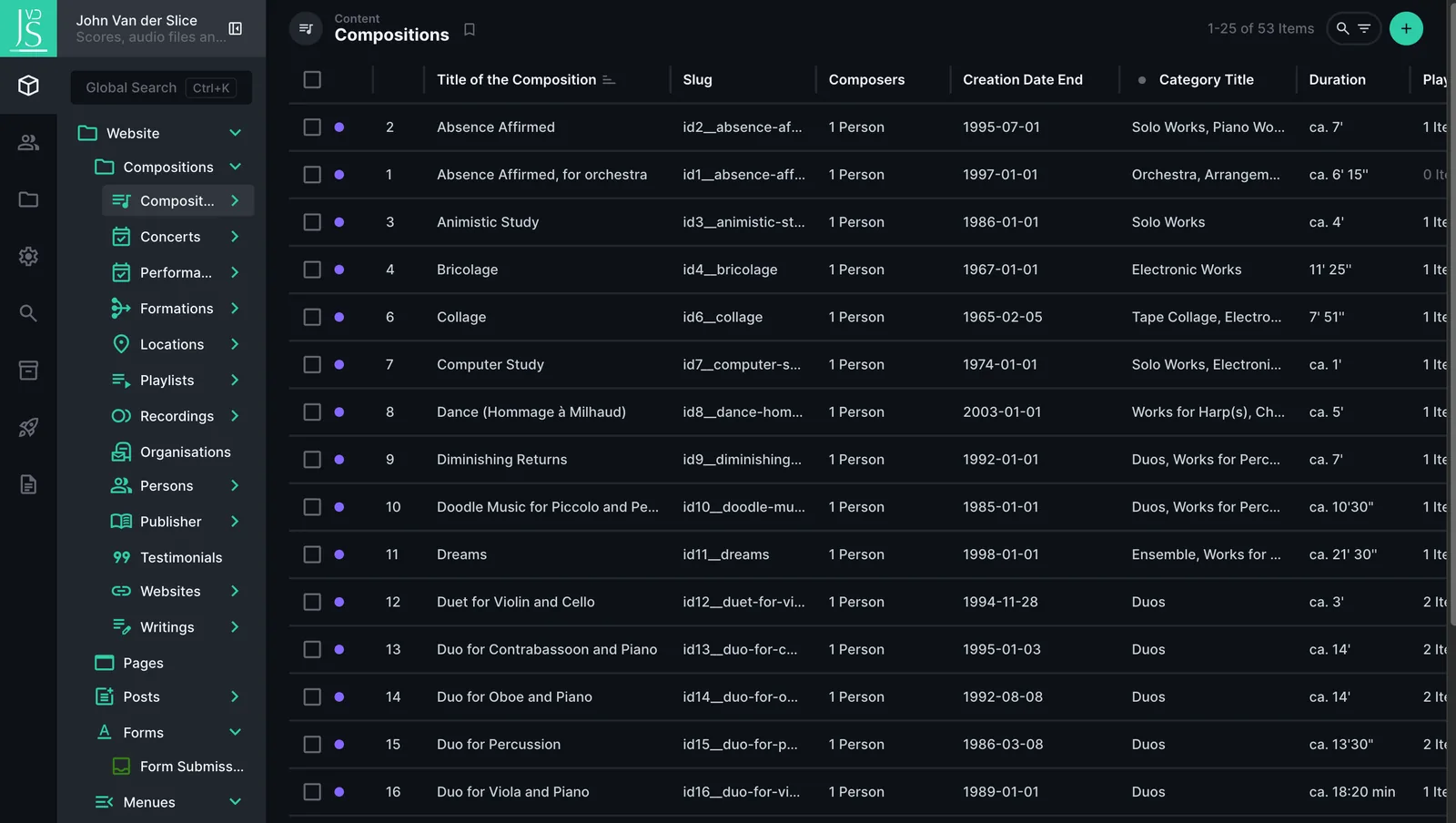
These are the collections of the catalogue. Together they cover the daily work of most organisations in music. Each record is kept once, where it belongs.
01
Works
The compositions themselves: title, scoring, instrumentation, dates, movements, programme notes, status.
02
People
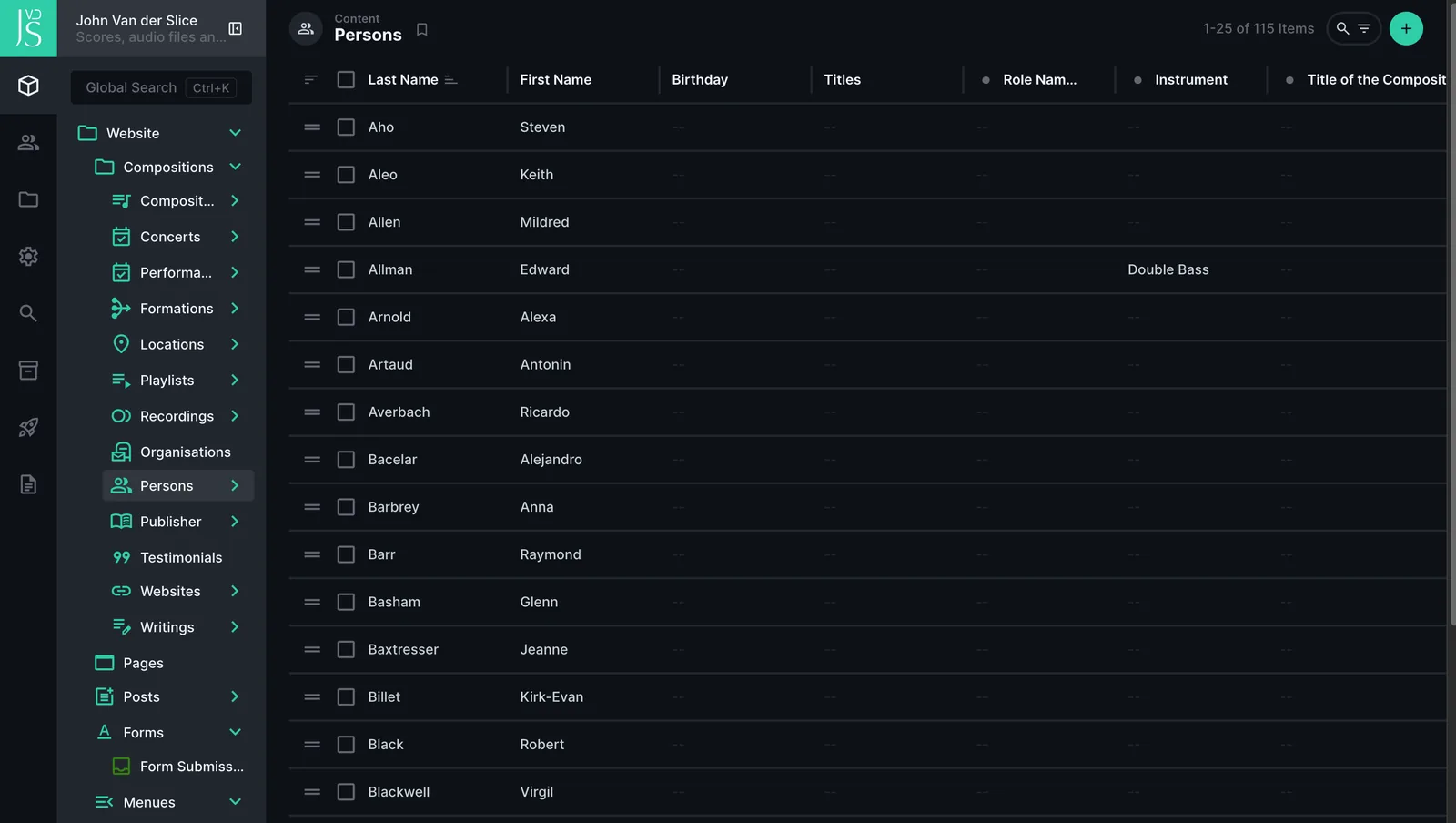
Composers, performers, conductors, poets, authors — each recorded once, with a role wherever they act.
03
Ensembles
Quartets, orchestras, choirs and other formations, with their members.
04
Venues
Halls, churches, studios and sites, with address and map coordinates.
05
Concerts and performances
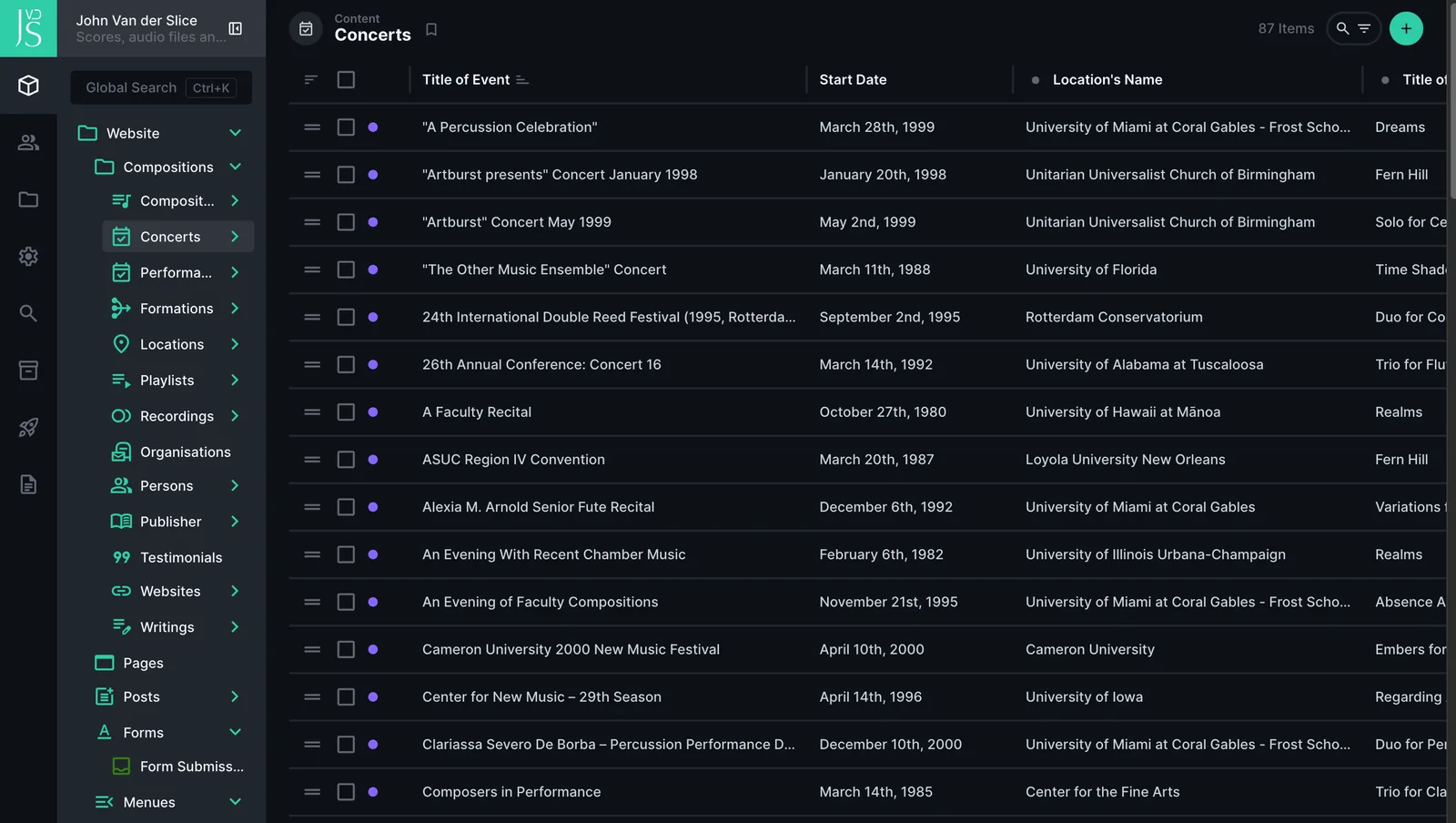
Dates, venues, programmes, performers, premieres — the timeline of a life's work.
06
Playlists
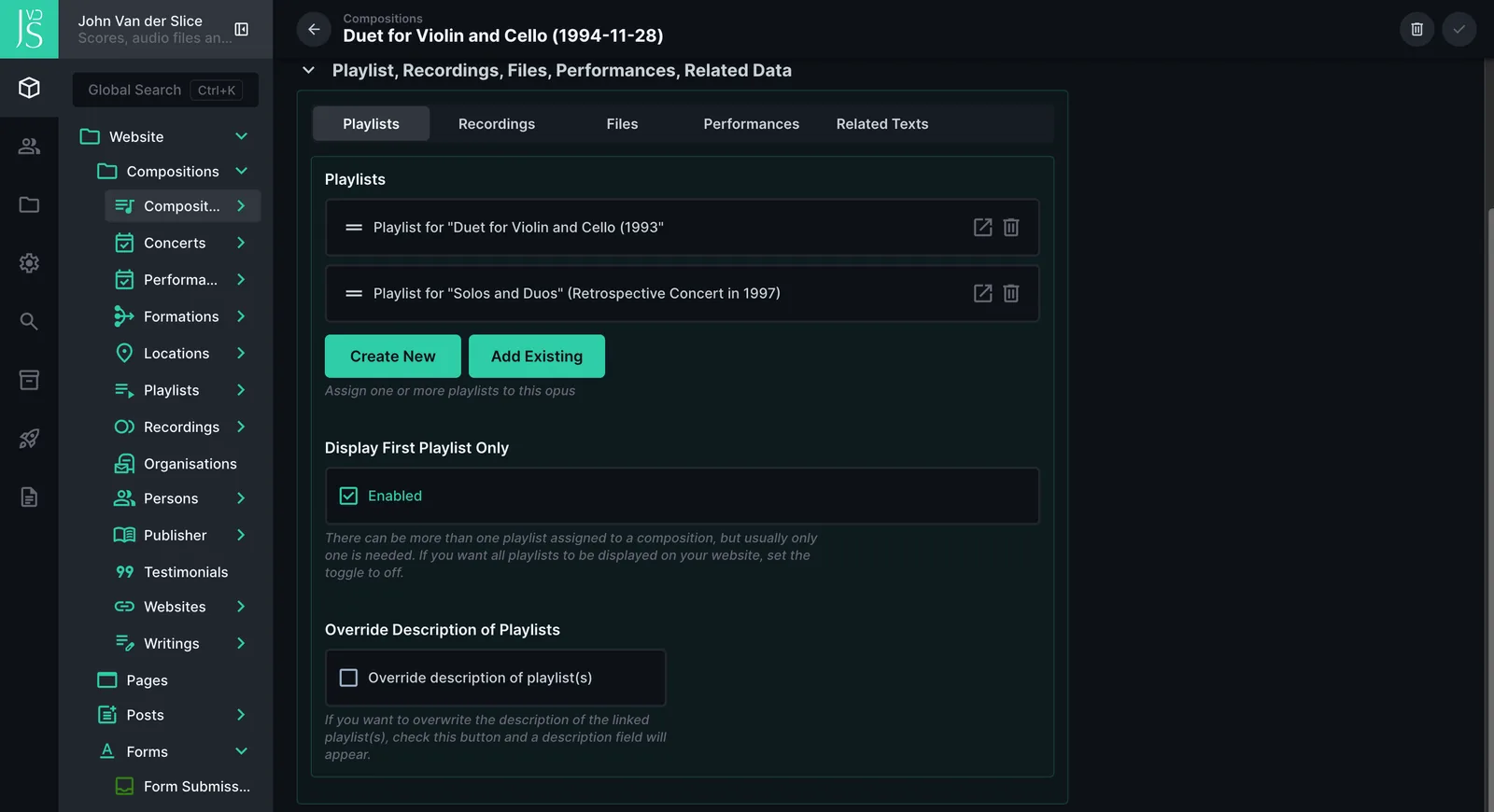
Ordered sets of audio files. A work refers to its playlist; the playlist carries the sound.
07
Recordings
Released albums with cover, booklet, publisher and the works they contain.
08
Publishers
Who publishes which work, in which edition and under which number.
09
Organisations
Institutions, festivals, universities, agencies.
10
Writings
Essays, reviews, interviews and texts, tied to the works and people they discuss.
Relations
Reuse, don't retype.
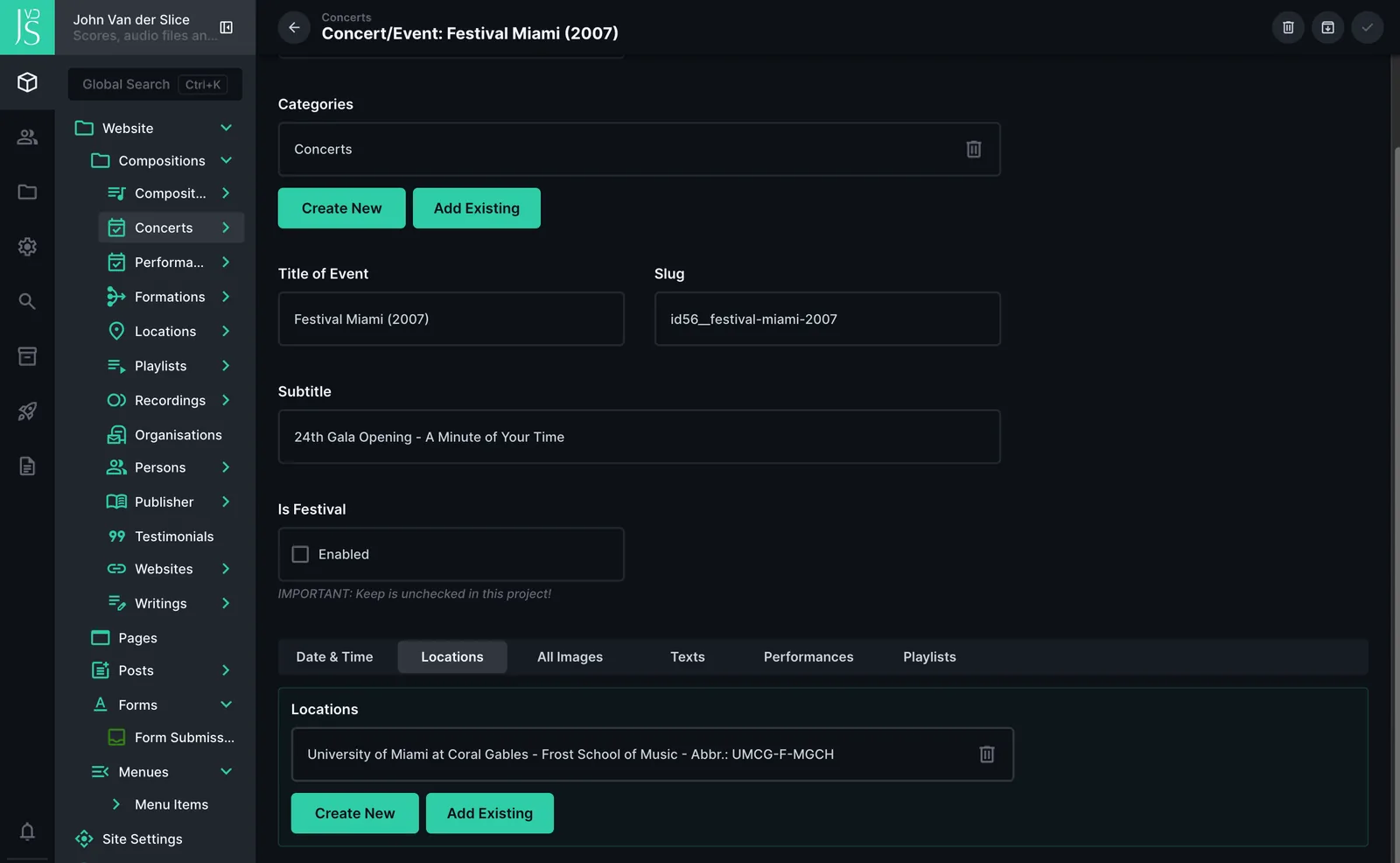
A relation is a connection between two records that lets one be shared by many. One performer, related to twenty works. One venue, related to fifty concerts. One publisher, related to a whole catalogue.
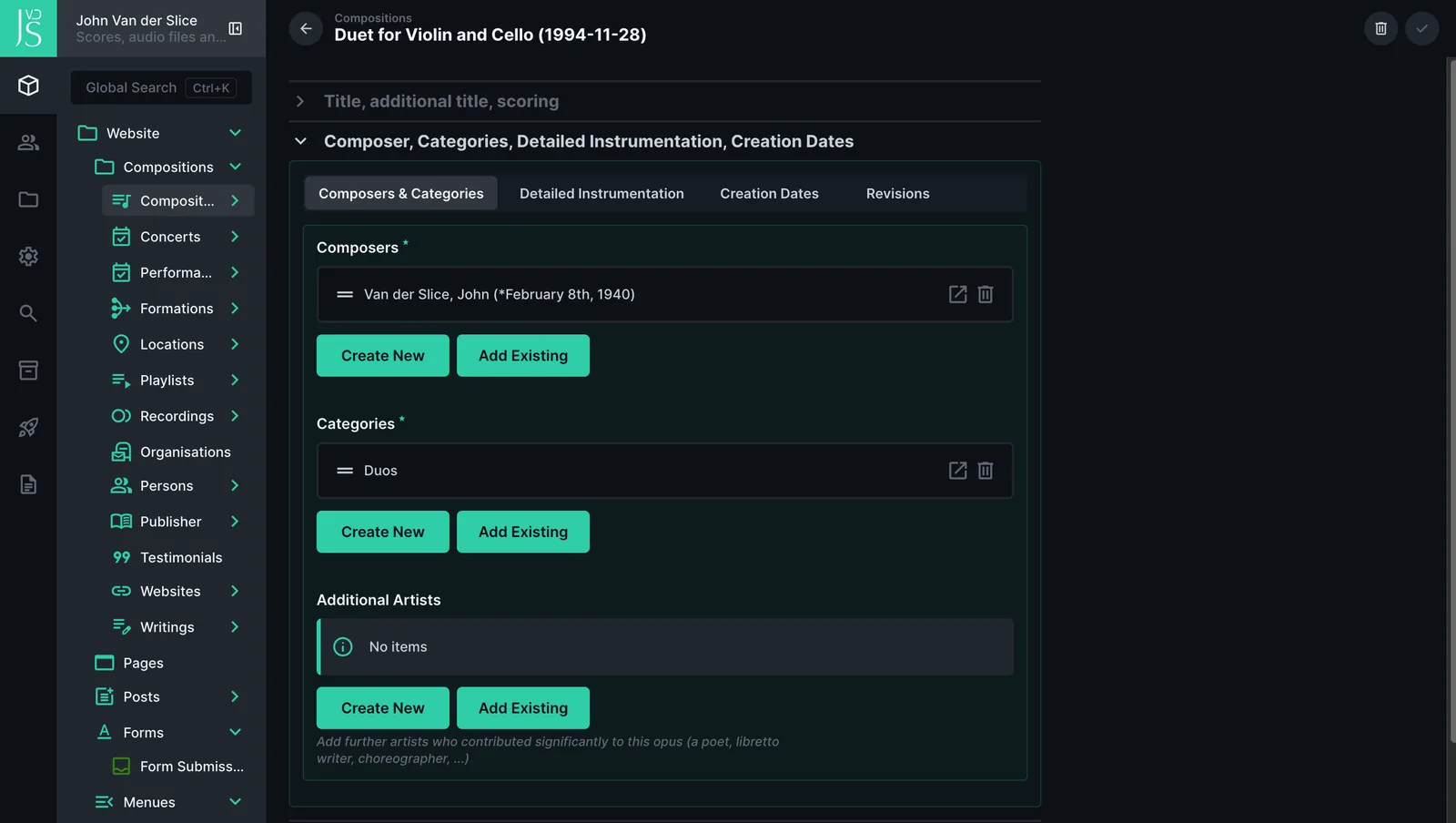
At the keyboard, the whole idea comes down to a habit. Add Existing draws a thread to something already in the system. Create New makes a record that is genuinely new to the whole catalogue. Searching always comes first.
That habit keeps a catalogue healthy for decades: no duplicate names, no half-told stories, no afternoon lost to untangling.
- Add Existing — always try this first.
- Create New — only for something genuinely new.
One record, one place. Relations tie them. Reuse, don't retype.
Editorial workflow
From a single work to a dependable body of records.
01
Create
Enter the work: title, scoring, duration, dates, status. Published, withdrawn or in progress — nothing is lost, only shown or hidden.
02
Relate
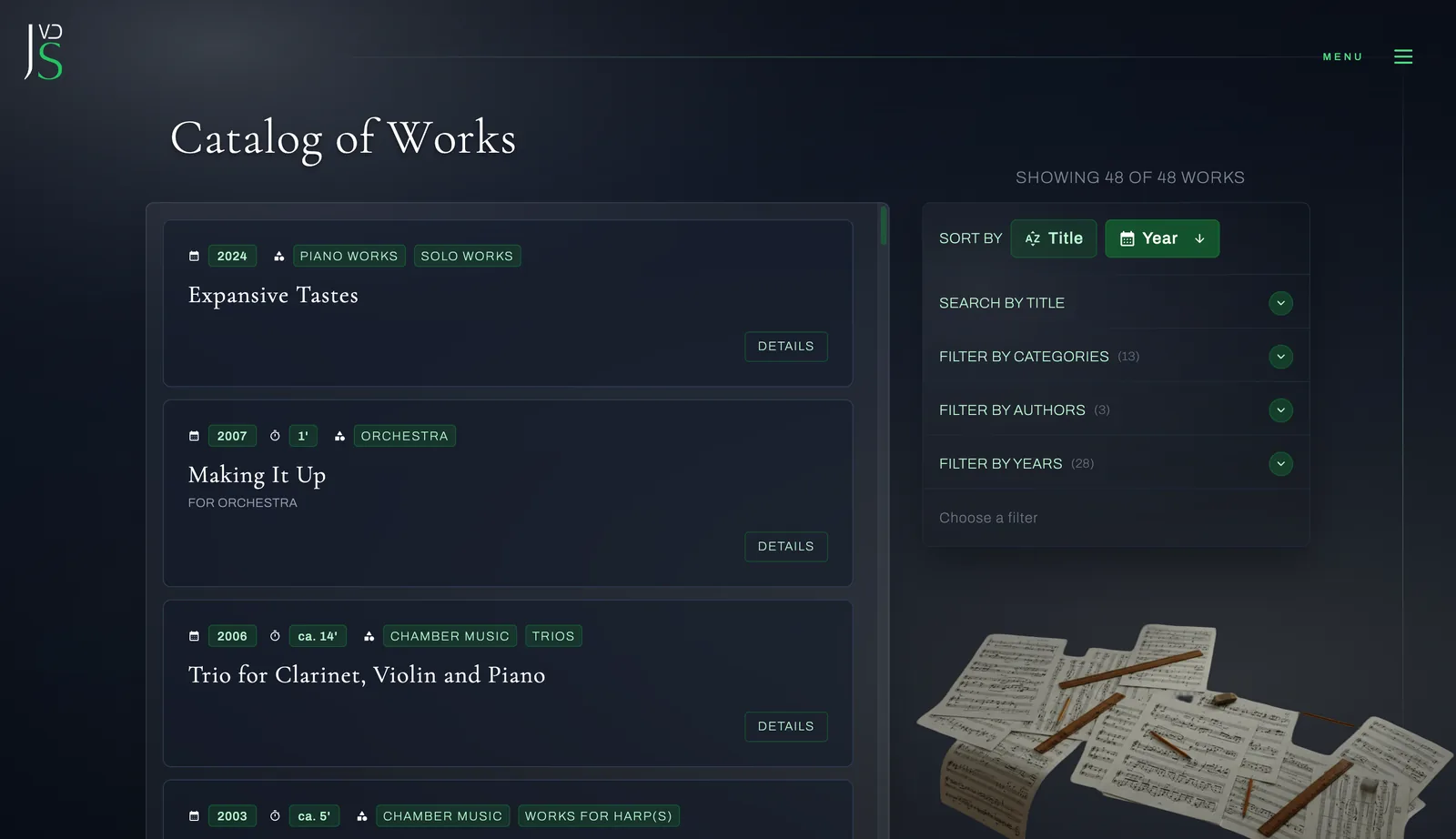
Composer, categories and further artists via Add Existing. The categories become the filters a visitor will use.
03
Describe
Programme notes, publisher, instrumentation, movements and versions.
04
Connect
Playlists, recordings, downloadable scores, performances and related texts — threads, never copies.
05
Publish
Set the status, save, reload. The website rebuilds its lists, filters and detail pages on its own.
Editorial environment
Directus. The catalogue has a desk.
Its collections mirror the musical world directly. What belongs together stands side by side; whatever a frontend needs, an API delivers.
- Works, people, places and events as collections of their own, joined by relation fields
- Scores, audio and images in the file library, right beside their entries
- REST and GraphQL for any frontend – Nuxt, an app, a print export
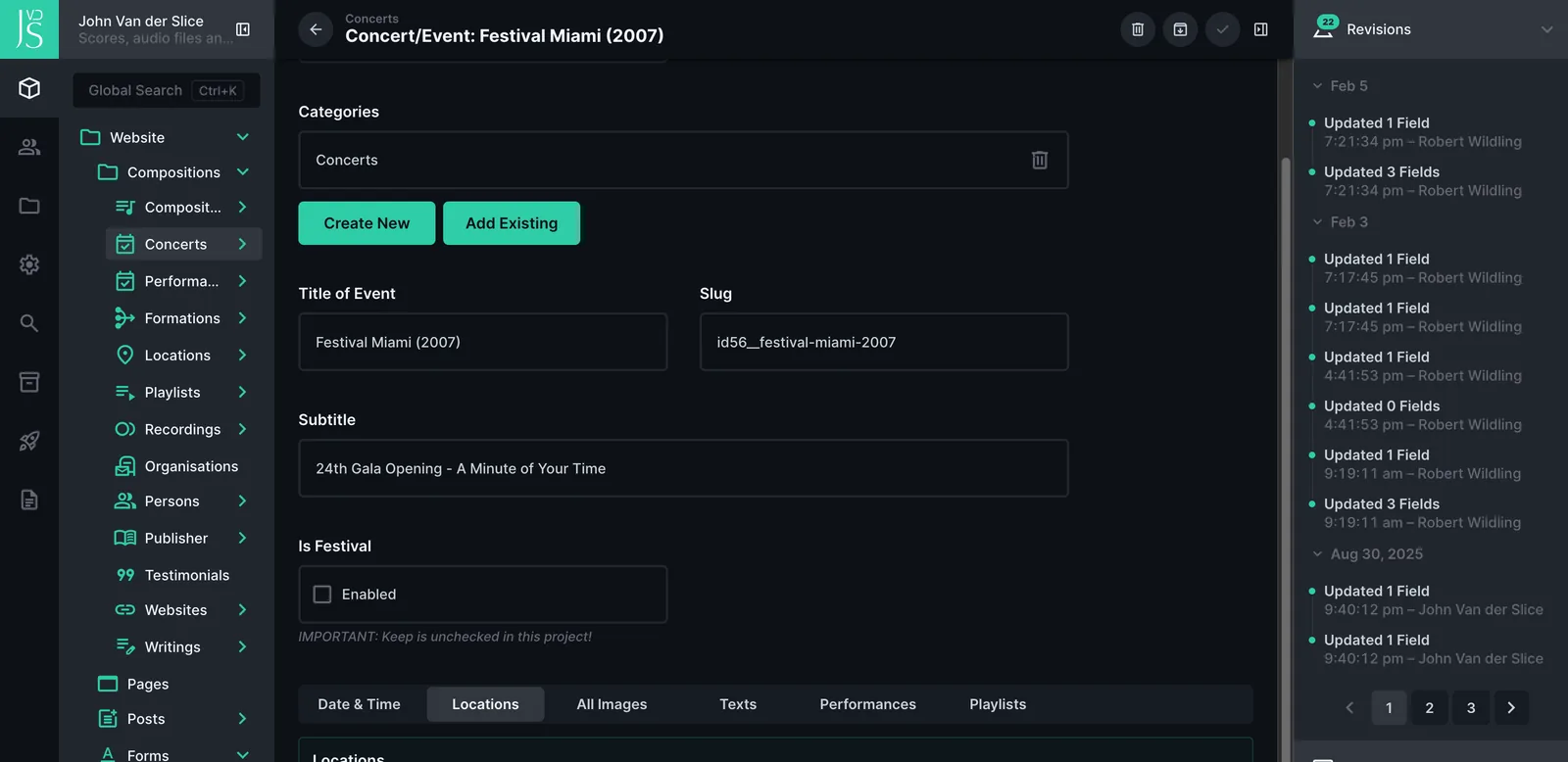
- Roles and permissions per person, revisions per entry
For whom
Built for composers. At home far beyond.
Whoever works with music meets the same words: works, people, groups, places, events, organisations, texts. Each profession emphasises a different one; all of them draw on the same small vocabulary.
Composers
Catalogue of works, concerts, recordings, writings — one connected world.
Concert and festival organisers
Programmes, dates, venues, and the performers of each evening.
Record labels
Releases, the works on them, the artists, the publishers.
Music publishers
Catalogued works, their composers, editions and numbers.
Artist and PR agencies
The people they represent, their engagements, their press.
Orchestras and ensembles
The groups, their members, the works and concerts they give.
Venues and cultural tourism
Halls and sites, their places on the map, their events.
Radio and streaming
Tracks, the works behind them, the artists who made them.
Archives, libraries, musicology
The documented history of works, people and performances.
Writers, journalists, critics
Texts and reviews tied to the works and people they discuss.
A look inside
Where the editing happens — and what the visitor sees.
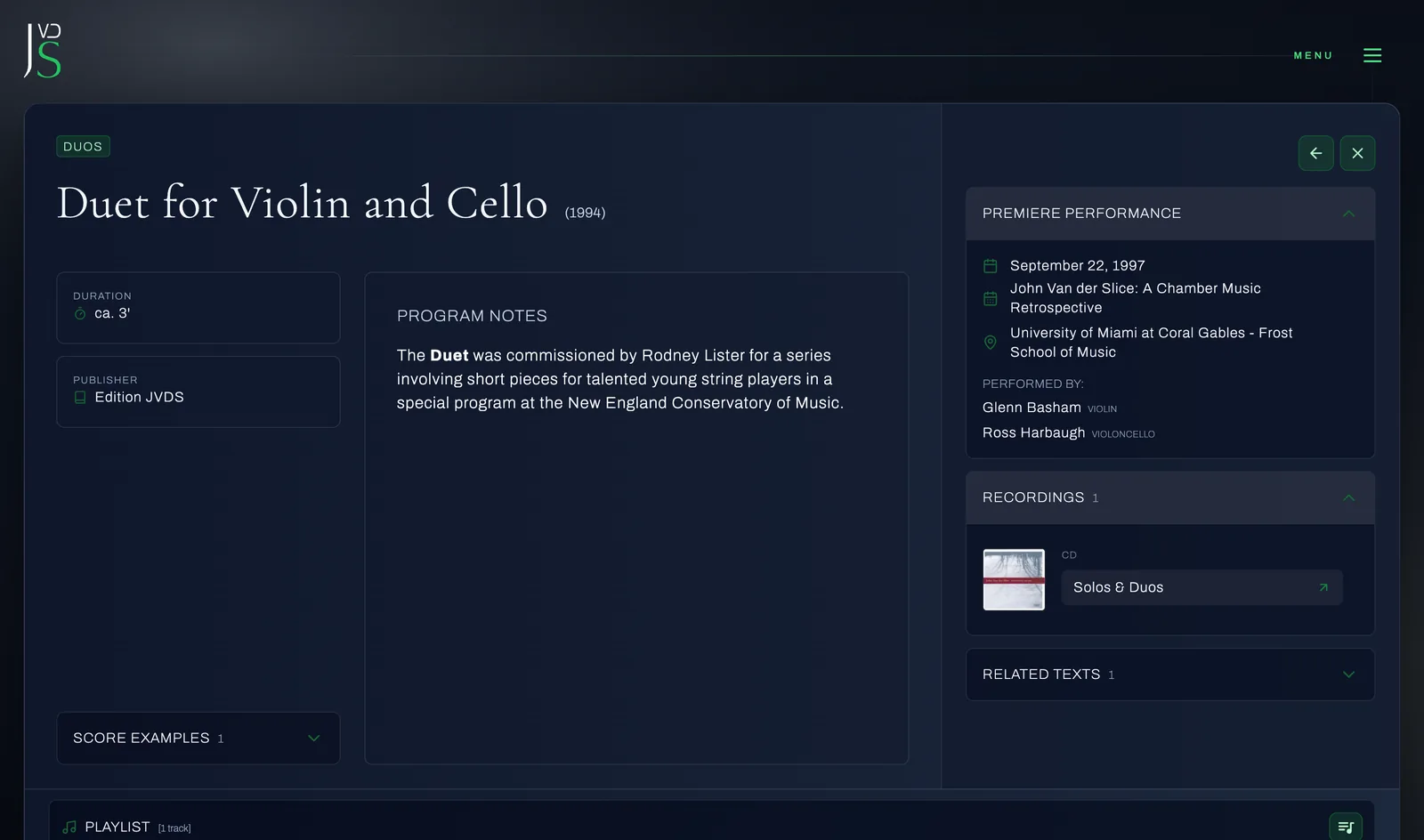
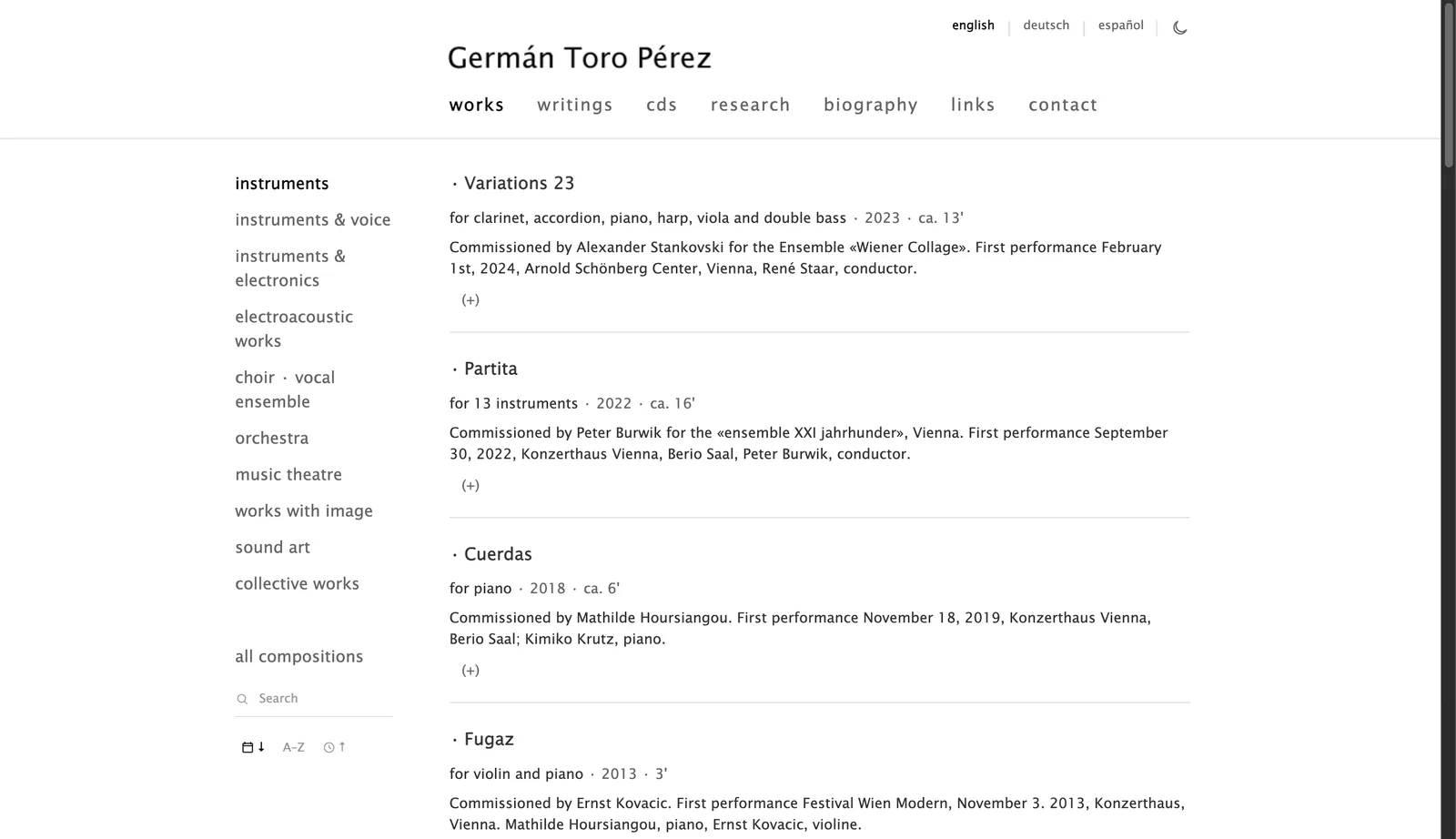
Screenshots from the Directus catalogue of composer John Van der Slice and from two public websites. Each caption names the place in the system.
Selected examples
Distinct websites, a shared memory.
A few of the websites that run on the catalogue. Kept by the people they belong to. They look nothing alike — which is rather the point.
- John Van der SliceComposer · teacher · music analyst
Catalogue, concerts with a globe of venues, recordings, writings and an audio player across the whole site.
Directus · EN - Germán Toro PérezComposer · researcher
Works by category, writings, CDs and research, in English, German and Spanish.
Directus · EN · DE · ES - Dennis KamComposer · conductor · teacher (1942–2018)
Catalogue of works with score downloads, listening examples and writings.
TYPO3 · EN - Michael AmannComposer · music educator
Works, concerts, writings, CD releases and audio from one editorial structure.
TYPO3 · DE · EN - Norbert SterkComposer · speech therapist
Catalogue of works, concerts, CDs and writings, continuously updated.
TYPO3 · DE - Alexander StankovskiComposer · music theorist
Compositions, media, writings and events from one connected model.
TYPO3 · DE
Working with it
The catalogue belongs to those who keep it.
A catalogue is only as good as the hands that tend it. So every project comes with a handbook, a safety net, and a person who answers.
A handbook
Illustrated tutorials, written for the website in question, explaining each task step by step — from uploading a photograph to entering a concert.
A safety net
Every save is kept as a revision. Nothing breaks for good; an earlier state is always a click away.
A person
When in doubt, a message is enough. It is answered, and whatever went astray is tidied up.